The AgFlow Intelligence
Weekly Signal

A structured framework for understanding what changed,
what matters, and what to watch next.

✓ Classify the soybean system state
✓ Identify the 2–3 signals that actually matter
✓ Understand where commercial risk is building
✓ Know when escalation is authorized—and when it isn't
✓ Separate structure, confirmation, and constraints

Research Library

Institutional Frameworks for Understanding the Soybean Market

The AGFLOW Research Library contains educational and analytical publications designed to help commercial operators understand the structure, transmission, and governance mechanisms that drive the soybean market.
Each publication focuses on a specific framework, concept, or market mechanism used by professional merchandisers, traders, processors, and commercial decision-makers.
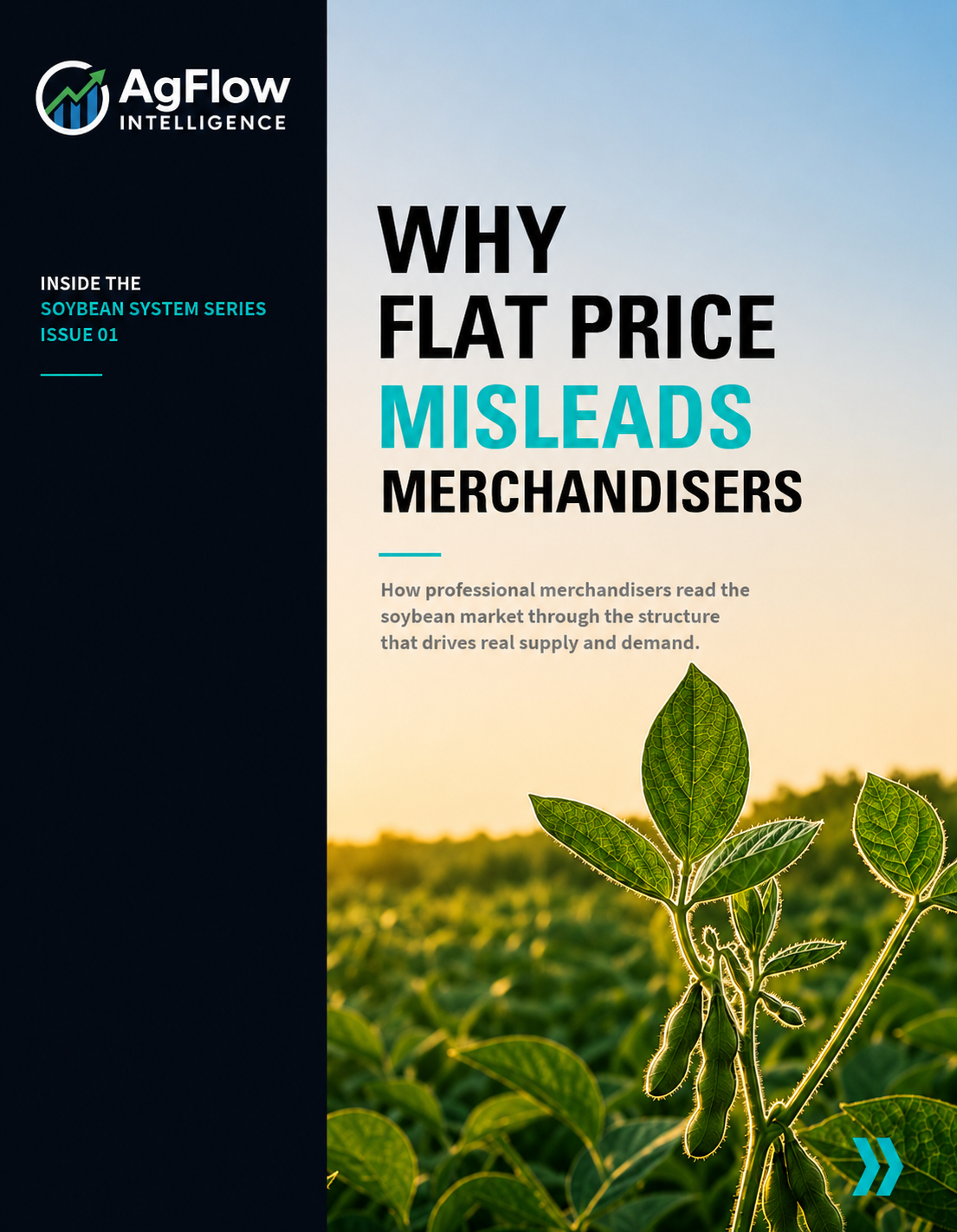
Inside the Soybean System Series
Issue 01


Why Flat Price Misleads Merchandisers

Most market participants interpret the soybean market through price.

Professional merchandisers interpret it through structure.

This report explains why basis, spreads, carry, inventory ownership, and physical flow often reveal changing market conditions before futures prices fully respond.

Learn how commercial operators identify tightening, duration risk, and physical stress by reading the signals beneath the board.

Who This Is Designed For

This governance framework is used across physical commodity operations
where execution discipline matters more than information access.

Grain Elevators & Merchandisers
— Physical inventory and hedge governance

Processors & Crushers
— Procurement discipline and execution control

Commercial Farmers
— Market-state interpretation and execution restraint
Feedlots
— Feed input governance under volatile regimes

Integrated Livestock & Protein Producers
— Systemic feed exposure oversight

Risk Committees & ICs
— Independent governance and audit reference
Tier selection depends on execution responsibility, not role or title.

Most errors occur inside balanced regimes, not extremes.
Most losses occur from acting too early, not too late.

The subscription cost is designed to be materially lower than the cost of a single false execution —
a premature hedge, an unnecessary liquidation, or an escalation based on misread tightness.

Prevents false execution in balanced and uncertain regimes.
That is what you are paying for.
Data-driven insights for the global agricultural markets.