COMMON QUESTIONS
About the Operator Brief framework.
How is this different from most market commentary?
Most agricultural commentary explains what prices did. AgFlow evaluates whether the soybean system is operationally confirming tightening, failing synchronization, or restricting escalation authority across the broader commercial environment. The framework focuses on structure, physical transmission, export synchronization, positioning instability, carry economics, and commercial execution conditions — not prediction. The objective is governed commercial decision-making.
What does “fail-closed” mean?
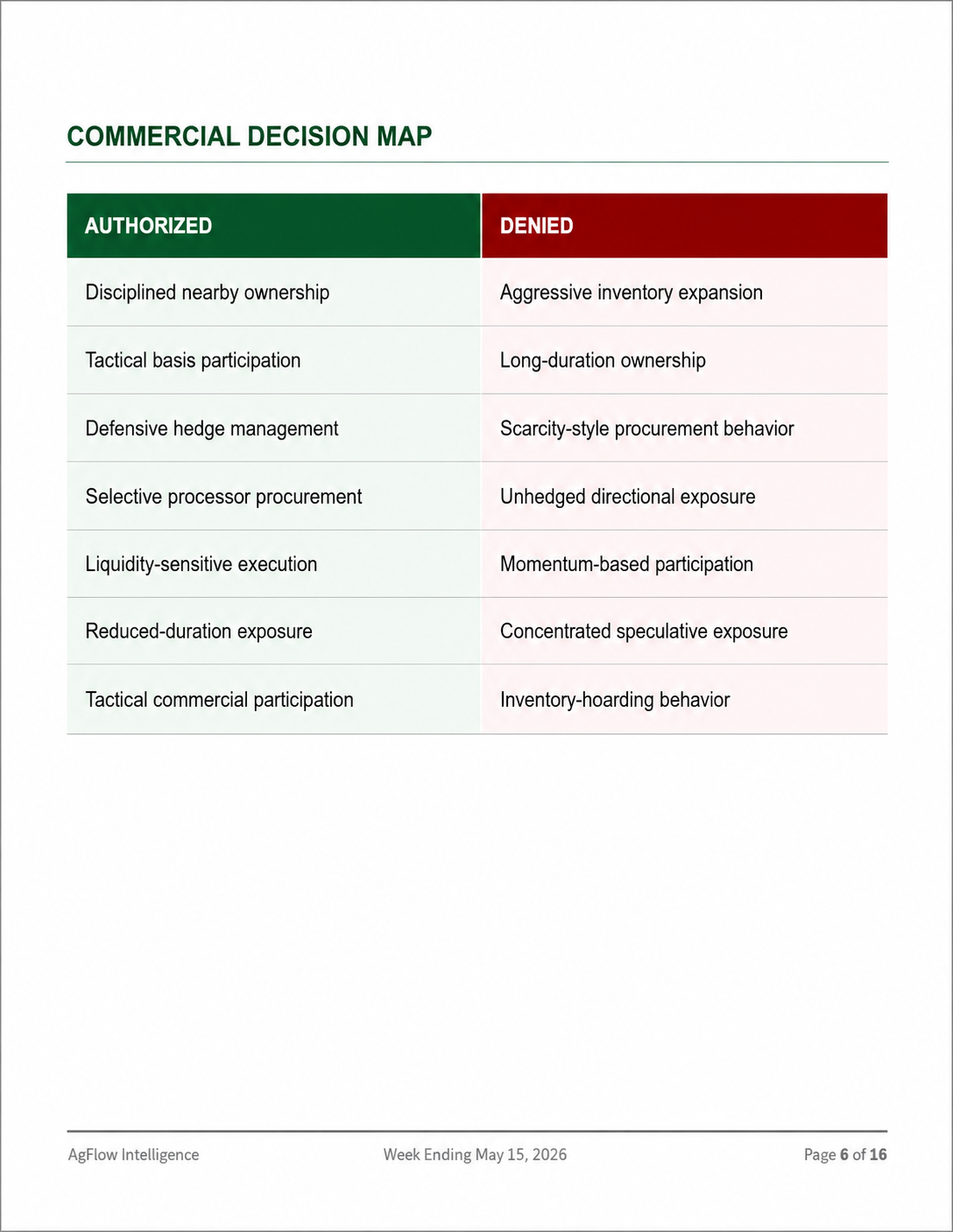
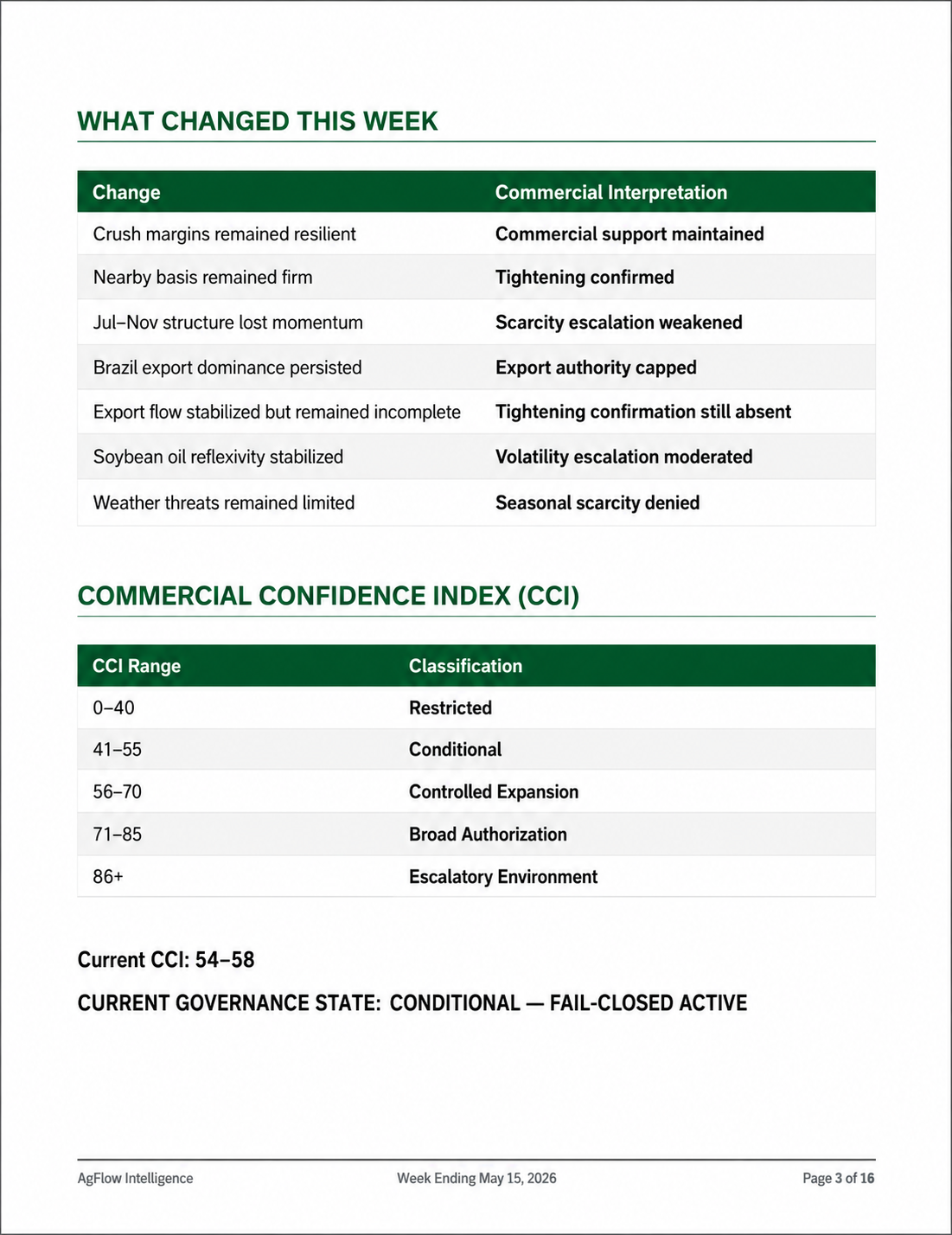
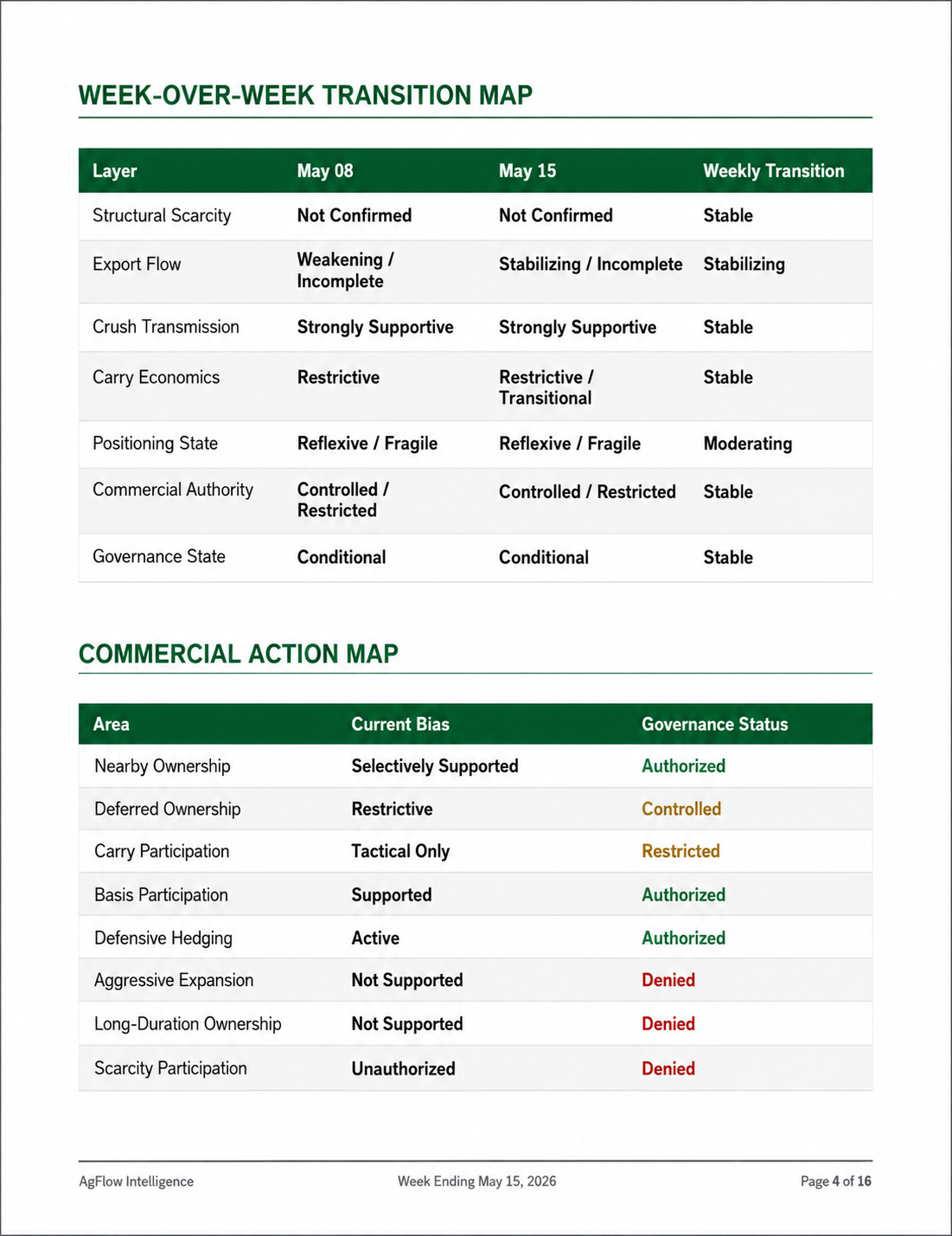
AgFlow operates under a fail-closed governance structure. The framework does not automatically authorize participation simply because prices are rising or nearby tightening exists. Escalation authority is granted only when confirmation aligns across structure, physical flow, spreads, basis, positioning, and synchronization quality throughout the soybean system. If confirmation deteriorates, participation becomes tactical, duration exposure remains reduced, escalation authority is restricted, and ownership expansion may remain denied. The objective is not maximizing conviction — it is controlling commercial decision risk.
Is this a signal service?
AgFlow is not a trade signal product. The framework is designed to help commercial operators evaluate tightening quality, synchronization conditions, inventory accessibility, positioning instability, and execution authority across the soybean system. It does not issue buy signals, sell signals, price targets, or directional forecasts. AgFlow evaluates whether the market currently supports participation — and under what conditions.
Who is the Operator Brief built for?
The framework is designed for commercial participants operating inside the soybean complex, including grain merchandisers, elevator operators, processor procurement teams, crush desks, commercial hedge managers, co-op risk teams, and regional trading operations. The briefing is built around the operational decisions these operators actually make, including basis participation, inventory duration, hedge governance, ownership exposure, and procurement timing.
What does the framework actually evaluate every week?
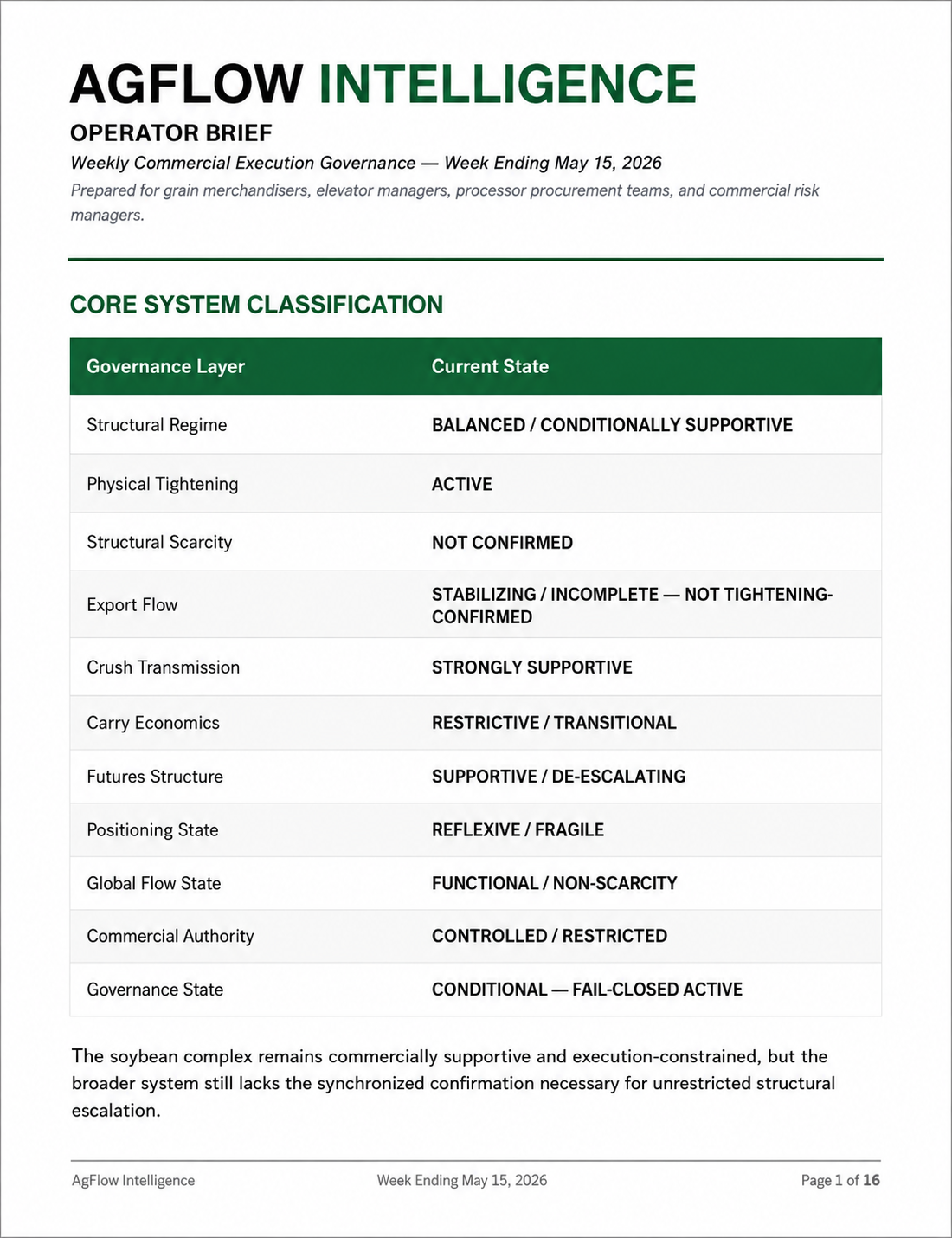
Every Monday at 8:30 AM, the framework evaluates structural regime conditions, physical tightening validation, export synchronization quality, crush transmission strength, futures escalation behavior, carry and duration economics, positioning instability and reflexivity, and commercial execution authority across the soybean complex. The report is organized into a repeatable sixteen-section governance architecture designed to evaluate the soybean system through the same decision hierarchy every week.
Why are the reports so detailed?
The soybean complex requires evaluating sixteen interdependent variables simultaneously. Compressing that into a headline creates exactly the kind of oversimplification the framework is designed to prevent. The depth is the discipline.
Is the data proprietary?
The underlying market data used by AgFlow is public. The proprietary layer is the governance framework itself — how the data is sequenced, how transmission is evaluated, how contradictions are reconciled, how escalation authority is classified, and how the final governance output is produced. The value is not raw data access. The value is governed commercial interpretation.